From alert ingestion to analyst-ready disposition — Specialist agents, autonomous threat hunting, attack narratives, and full compliance mapping.
Patent pending
An intelligent orchestrator routes each alert to the right specialist agent. Multiple routing modes balance speed and accuracy for every scenario.
Detects credential stuffing, password spraying, and brute force authentication attacks across all protocols.
Analyzes email-based threats including spear phishing, BEC, credential harvesting, and malicious attachments.
Identifies malicious software execution, persistence mechanisms, C2 communication, and payload delivery.
PowerShell analysis, Event Log tampering detection, Active Directory attacks, registry modifications, and scheduled task abuse.
Network reconnaissance detection, scanning patterns, and network sweep identification.
URL access monitoring, malicious domain detection, DNS filtering, and web-based threat analysis.
Detects SMB/RDP/SSH lateral spread, pass-the-hash, PSExec, WMI execution, and east-west traffic anomalies.
Cross-platform detection: Linux sudo/SUID abuse, Windows UAC bypass, Cloud IAM escalation, and token theft.
Flexible agent that handles any alert type not covered by specialist agents using general security analysis.
Every alert passes through a rigorous seven-step pipeline before reaching an analyst.
Alerts from 6 supported SIEMs are received via native connectors and queued for processing.
Raw alerts are normalized to a consistent schema, extracting structured fields (source IP, event type, severity, timestamps) regardless of SIEM format.
Automated lookups against multiple threat intelligence sources and internal context provide additional enrichment for every indicator.
Each specialist agent applies domain-specific heuristics to generate an initial risk score and engineered signals before LLM analysis.
Relevant knowledge base documents are retrieved and intelligently ranked to surface the most useful context for each alert analysis.
The specialist agent synthesizes normalized alert data, enrichment results, heuristic signals, and knowledge base context to produce a structured analysis with disposition, confidence score, and reasoning.
Alerts are classified into one of 8 dispositions (true positive, false positive, benign, duplicate, etc.) and routed to the appropriate action: escalate, create incident, trigger SOAR playbook, or auto-close.
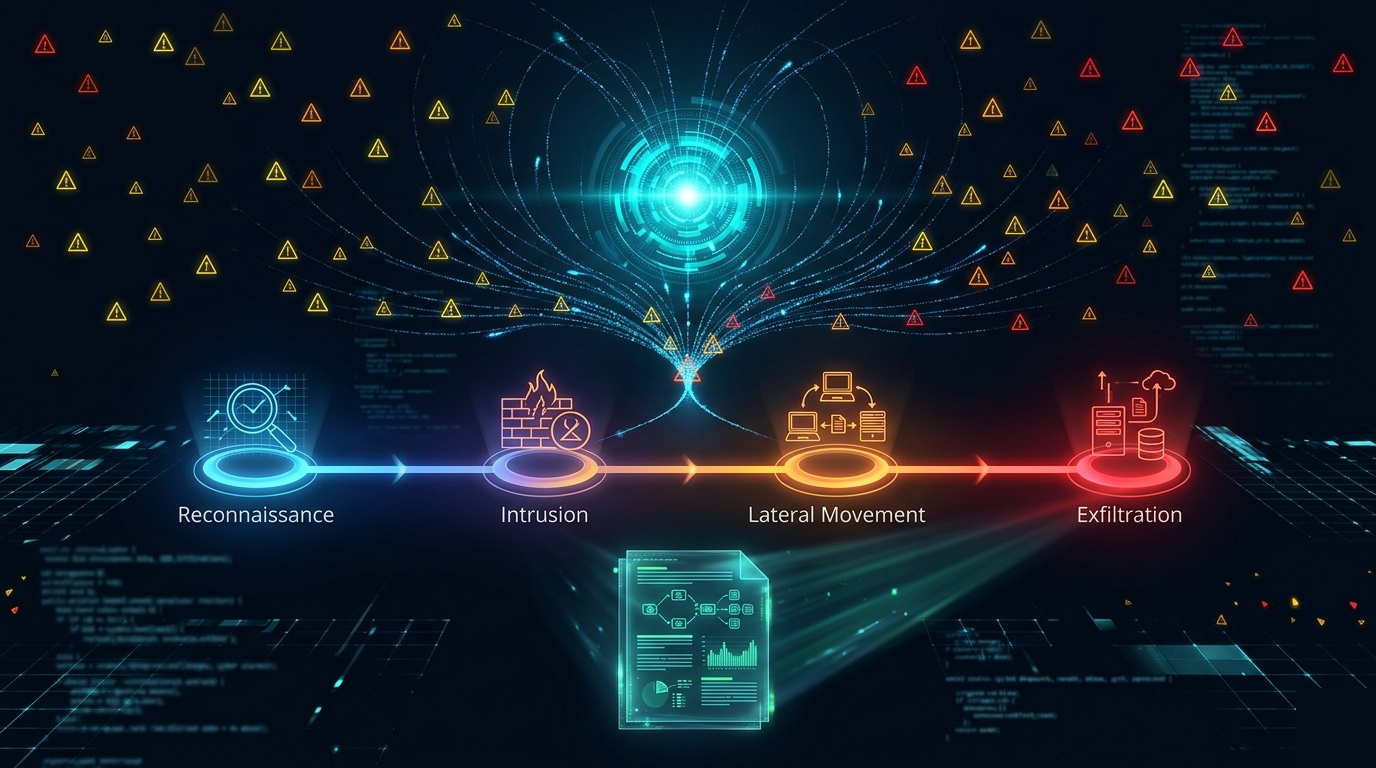
Intruex doesn't just triage alerts — it connects the dots. Related alerts are automatically correlated into attack campaigns with plain-English narratives that tell the full story.
Related alerts are automatically grouped into attack campaigns based on shared indicators — IPs, users, hosts, and timing patterns. No manual correlation required.
Every alert and campaign is mapped to kill chain phases — from initial reconnaissance through lateral movement to exfiltration — so you see exactly where an attack stands.
IPs, usernames, hostnames, domains, and file hashes are automatically extracted and cross-referenced across every alert in the campaign.
AI generates a human-readable summary of the entire attack campaign — what happened, what's affected, how far it progressed, and what to do next. Ready for executive briefings or incident reports.
Background agents run continuously without human initiation — proactively hunting for threats, reviewing analysis quality, and investigating anomalies around the clock.
Proactive anomaly detection that runs 24/7 without analyst intervention.
Grades every AI analysis for quality and consistency, creating a continuous feedback loop that makes the platform smarter over time.
Automated deep-dive threat investigations that gather evidence, correlate indicators, and build investigation timelines without analyst involvement.
Continuous log pattern analysis that watches for emerging threats and anomalies in real time across all ingested log sources.
Upload your security documentation. Intruex's AI reads it, understands it, and uses it to make better decisions on every alert.
Upload PDF, DOCX, and TXT files. Your documents are automatically processed, indexed, and made available to every AI agent for contextual decision-making.
When an agent analyzes an alert, it automatically searches your knowledge base for relevant context — runbooks, escalation procedures, known issues — and factors it into the analysis.
Your organization's unique security policies, exception lists, and tribal knowledge become part of every AI decision — not just generic threat intelligence.
Define organization-specific rules that override AI decisions. For example, always escalate alerts from specific IP ranges or always classify certain event types as benign.
Agents don't analyze alerts in isolation. Three layers of memory give every analysis the context of everything that came before — reducing false positives and surfacing patterns a single-alert view would miss.
Maintains context during active alert processing and analyst conversation threads. Ensures continuity within a single investigation session.
Tracks recent activity per user, IP, and host across all alerts. Agents automatically cross-reference current alerts against recent entity behavior.
Stores analyst-approved organizational knowledge permanently. Tribal knowledge that would take months to learn is available to every agent on every alert.
Analysts don't just read AI decisions — they challenge them. Conversational threads let your team interrogate any disposition with follow-up questions and get cited evidence in return.
Why did you classify this as benign? The source IP has a bad reputation.
The IP 203.0.113.5 was flagged by threat intelligence (reputation score: 45/100), but entity memory shows this IP belongs to a known vulnerability scanner authorized by your organization on 2026-02-15 (alert #4521). The KB rule “authorized-scanners” classifies all traffic from this range as benign.
Got it. Override to false positive — let's tune the SIEM rule.
Ask follow-up questions on any alert. The agent retains full analysis context and responds with specific evidence — not generic explanations.
Every response references specific data: enrichment results, entity memory lookups, knowledge base matches, and heuristic factor breakdowns.
Analysts can override dispositions directly from the conversation. Overrides feed back into entity memory, making future analysis more accurate.
Every conversation turn is logged with timestamps and trace IDs for compliance, forensic review, and analyst training.
Intruex multiplies analyst capacity and compresses response timelines. The analyst's job shifts from building the investigation to validating and acting on it.
Pre-analyzed in ~1 minute. 29 minutes for human review and escalation.
Analyst opens raw SIEM alert and starts from scratch
Analyst opens pre-analyzed alert with disposition, risk score, and context
Manually searches for related events across tools
Similar incidents and attack narratives auto-generated
Writes escalation summary from scratch
Escalation package with timeline, IOCs, and recommendations pre-built
Senior analysts spend time on false positives
AI pre-filters noise — analysts focus on real threats
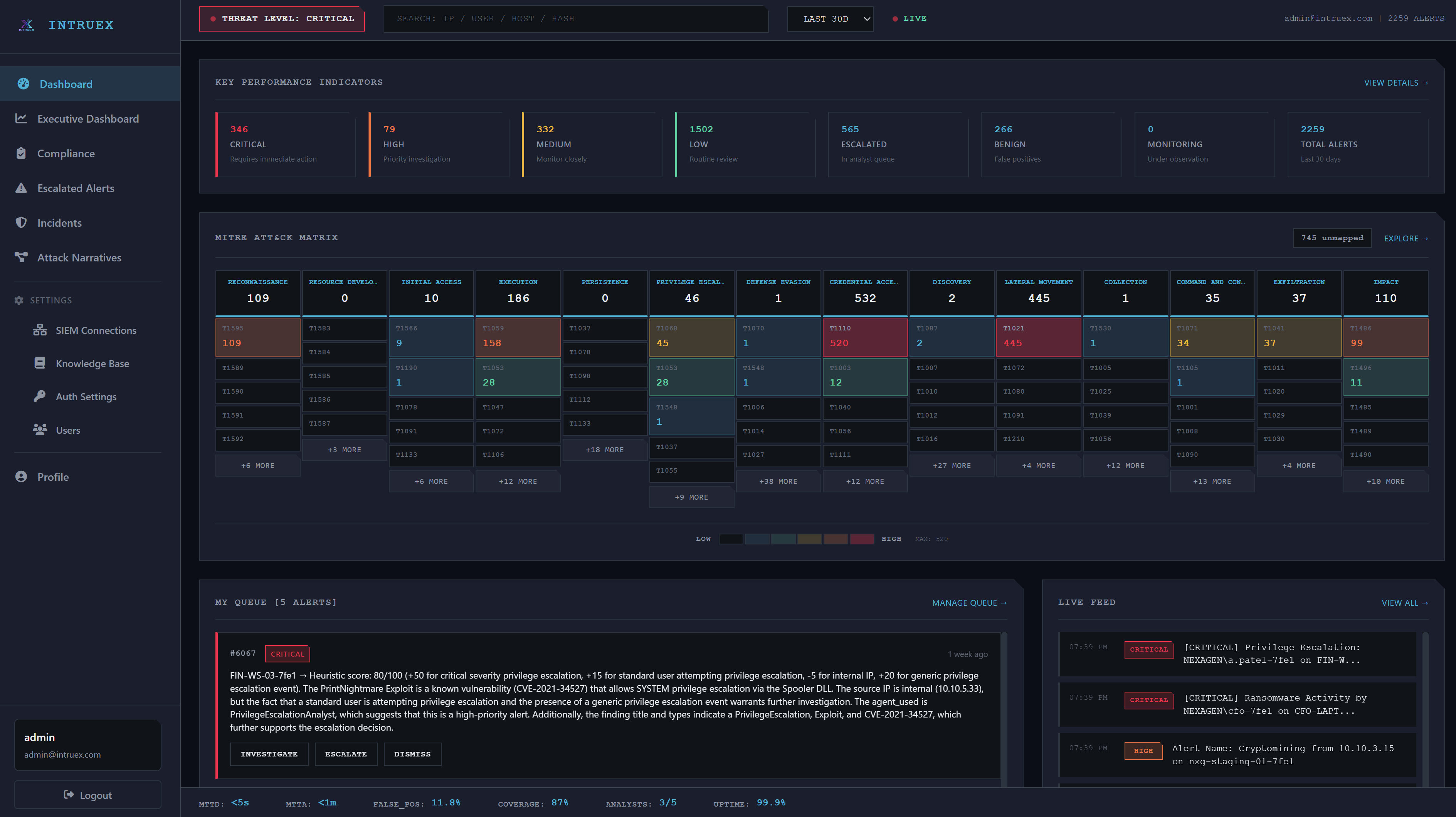
An interactive heatmap that maps every alert to the MITRE ATT&CK framework — giving you instant visibility into which adversary techniques are active in your environment.
Full MITRE ATT&CK matrix with technique hit counts. Click any technique to drill into the alerts that triggered it.
See attack progression across kill chain phases — from reconnaissance to impact — and identify where to break the chain.
Color intensity maps to threat frequency. Instantly spot the techniques attackers are using most in your environment.
Techniques sorted by hit frequency with zero-hit rows automatically collapsed — focus on what matters.
Complete visibility into your SOC operations with real-time metrics and actionable insights.
Map every alert and incident to the compliance frameworks that matter to your organization. Powered by Secure Controls Framework (SCF) with LLM-powered analysis for intelligent cross-framework coverage. The MITRE ATT&CK heatmap doubles as a visual compliance tool, showing technique coverage at a glance.
Payment card industry data security standard compliance mapping and reporting.
National Institute of Standards and Technology Cybersecurity Framework alignment.
Health Insurance Portability and Accountability Act security rule compliance.
Service Organization Control Type 2 trust services criteria reporting.
International information security management system standard mapping.
Tactic and technique mapping for adversarial behavior classification and coverage analysis.
LLM-powered SCF analysis provides a unified control catalog that maps across all frameworks — one control set, complete cross-framework coverage.
AI that acts, not just advises. Intruex ships with a built-in SOAR engine — automated response actions out of the box, with full support for your existing SOAR platform.
No separate SOAR purchase required. Intruex includes automated response playbooks that execute the moment a disposition is made — disable accounts, reset passwords, isolate hosts, block IPs and domains.
AI disposition and confidence scores automatically trigger the right playbook. True positive phishing? Quarantine the email and reset the credential. Confirmed brute force? Lock the account and block the source IP.
Already using Palo Alto XSOAR, Splunk SOAR, or ServiceNow? Intruex integrates as the AI triage layer — feeding enriched, dispositioned alerts directly into your existing workflows.
Every automated action is logged with full context: what was triggered, why, what happened, and the outcome. Complete traceability for compliance and forensic review.
Same platform. Same features. Same agents. Deployed wherever your mission requires — from the cloud to fully air-gapped classified networks.
Cloud-hosted with multi-model AI. Fully managed infrastructure so you can focus on security, not servers.
Self-hosted on your infrastructure. Full control over data residency, network boundaries, and compute resources.
Fully disconnected networks with high-performance local inference. Built for classified environments and high-security operations.
Built from the ground up for enterprise-grade security, isolation, and compliance.
Complete organization-level data isolation. Every query filters by organization_id. No cross-tenant data access.
Granular RBAC with role-based permissions. Control who can view, analyze, escalate, and configure at every level.
Enterprise single sign-on via OAuth 2.0. Integrate with your existing identity provider for seamless authentication.
Each organization can customize SIEM connectors, knowledge base rules, compliance mappings, and notification preferences.
Comprehensive logging of every action, decision, and configuration change for compliance auditing and forensic review.
Generate, rotate, and revoke API keys per organization. Scoped permissions and usage tracking for every key.
See how specialist AI agents, autonomous threat hunting, and attack narratives can transform alert overload into actionable intelligence for your SOC.